
In Alberta’s oil and gas sector, regulation isn’t something you encounter once a year in a boardroom—it’s something you work around every day in the field. Whether you’re programming a flow computer, scheduling meter calibrations, or trying to figure out why one site keeps throwing red flags in Petrinex, the regulations—Directive 017, Directive 060, TIER—are not abstractions. They’re the system that dictates how, when, and why a site is considered compliant. And lately, the system is shifting.
This article looks at how those regulations are currently applied, how they intersect in real-world operations, and why even seasoned field teams are recalibrating more than just meters.
Measuring More Than Volumes: The Reach of Directive 017
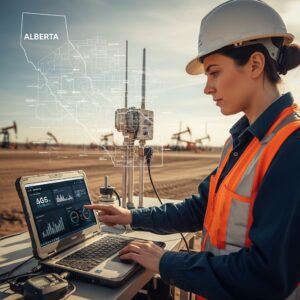 Directive 017 has long been the backbone of measurement compliance in Alberta. Updated most recently in December 2024, it outlines everything from which meters require proving, to how uncertainties are calculated, to what conditions invalidate a run. Its influence is technical and detailed—but its implications are operational and wide-reaching.
What’s less obvious to those outside the measurement world is just how much of a facility’s regulatory credibility rides on these technical standards. A site that doesn’t meet 017 standards risks more than just a flagged report; it risks audit exposure, invalid royalty submissions, and potential shutdown orders. With recent updates now incorporating geothermal and thermal-bitumen references, and tighter requirements around flashing and drive gain logic, the bar continues to rise—not just for accuracy, but for defensibility.
And while the directive reads like a technical manual, what it actually governs is workflow: how proving is scheduled, what evidence gets logged, and who has authority to adjust a meter in the field.
Case in point: A mid-sized operator managing ~60 wells engaged Intricate to assess meter proving and condensate reporting. Intricate restructured their entire approach—proving inline and bench meters in parallel, identifying and removing 12 reference-only meters from compliance scope, correcting misclassified volumes, and bundling condensate sampling into a single visit. The result? ~25% reduction in total cost and ~$30,000 saved annually.
The Quiet Impact of Directive 060
Directive 060 is often thought of in terms of flaring and venting limits, but its influence runs deeper. For upstream operators, it governs how emissions—particularly methane—are managed, measured, and reported. This includes pneumatic device mapping, leak detection thresholds, compressor seal vent testing, and quantification of gas that never makes it into sales.
The consequence of that is this: where Directive 017 governs what’s measured, Directive 060 starts to define what’s missing. It asks companies to account for volumes that never cross a meter—and to prove how they got those numbers. That’s where many operations quietly start to feel the pinch. Because unlike volume measurement, emissions measurement often spans multiple teams: field techs, instrumentation, measurement analysts, regulatory leads. The data might live in five places. Getting it right isn’t just about knowing the rules—it’s about coordinating them.
This directive, particularly in its interplay with Directive 017 and the TIER framework, also puts pressure on accuracy from a different angle. Not just how well you measured—but how completely.
TIER and the Shift from Measurement to Economics
 While the AER governs how things are measured, Alberta’s TIER program governs how those measurements translate into carbon cost. Introduced in 2020 to replace CCIR, the Technology Innovation and Emissions Reduction (TIER) program is Alberta’s carbon pricing system for large industrial emitters. If Directive 060 asks “How much methane are you emitting?”—TIER follows with “And what are you doing about it?”
Compliance under TIER can take several forms: reducing emissions onsite, using credits, purchasing offsets, or paying into the TIER fund. For oil and gas operators, especially those with high combustion or venting footprints, this translates into a very specific kind of pressure: turn emissions data into cost projections.
But here’s the kicker. That data has to come from somewhere, and more often than not, it starts at the meter. If your flow meter calibration data isn’t clean, or if your proving logic isn’t traceable, then your emissions math isn’t defensible. Which means the foundation of TIER compliance is still—quietly—Directive 017.
A strong example is a 90-site operation that used Intricate’s vent gas capture strategy to eliminate 100% of previously vented gas. The captured gas was monetized via offsets, enabling the operator to reduce their TIER liability and generate revenue from what was previously a loss. ROI was achieved in under 2.5 years, with returns boosted by low capex and minimal maintenance cost.
What’s Coming: Compliance at the Edge of Policy and Practice
For most of the last decade, regulatory change in Alberta’s oil and gas sector has followed a predictable rhythm—incremental updates, long implementation windows, and technical guidelines that, while complex, stayed within the realm of engineering logic. That rhythm is starting to break.
The next wave of compliance challenges won’t just come from revised proving procedures or new offset protocols. They’ll come from uncertainty—about where carbon pricing is headed, what counts as verified measurement, and how political and economic interests will reshape the rules mid-cycle. And they’ll come faster.
This isn’t just a problem for corporate. It’s already reaching the field.
Carbon Politics, Price Freezes, and the Optics of Compliance
When Alberta’s government announced the 2025 carbon price freeze at $95 per tonne—halting the trajectory toward $170 by 2030—it framed the move as a necessary protection for producers facing global cost pressure. It was partly an economic decision. But it was also a political one.
The messaging wasn’t just about fairness—it was about control. Alberta positioning itself as the counterweight to federal environmental mandates. But whatever the motive, the freeze did more than pause a price—it introduced volatility. Producers now have to plan for emissions obligations in an environment where the rules could shift every budget cycle. Will the freeze hold? Will it harmonize with federal carbon benchmarks? No one knows for sure.
For companies trying to build five-year compliance plans, this has real operational fallout. It doesn’t matter how strong your emissions strategy is if the pricing framework changes under your feet. And for field teams, it means the target isn’t just moving—it might vanish and reappear somewhere else.
Data, Automation, and the Audit Horizon
Regulatory focus is increasingly shifting from compliance by report to compliance by data trail. It’s no longer enough to prove you ran a meter check. You need to prove how, when, under what conditions, and with what calibration history. And you need to do it in a format that survives audit.
Directive 017 already set the tone for this. But AER isn’t the only one watching anymore. TIER compliance reporting, emissions offset validation, and even OneStop submissions are starting to operate under the same assumption: if it’s not logged, serialized, and traceable—it didn’t happen.
This creates a subtle, high-stakes pivot in how compliance gets executed. Manual spreadsheets and standalone field notes don’t cut it. Systems need to talk. Software needs to match what’s in the field. And techs need to know that what they do on-site may show up in a compliance review three years later.
Spreadsheets, Job Security, and the Fear Behind Resistance

What rarely gets said—at least in public—is that the industry’s slowness to adopt better systems isn’t always
about budget or complexity. It’s about survival. In a lot of shops, compliance still lives in spreadsheets because that’s where people feel safe. The system may be clunky, manual, and error-prone, but it’s also something people know how to defend. Bring in automation, and you don’t just change the workflow—you challenge the job.
That’s a real tension. For someone whose role revolves around tracking calibration logs or managing volume submissions, software that replaces that process doesn’t look like support—it looks like risk. That fear is slowing the entire sector down. Not because tech can’t do the job. But because we haven’t built the trust that it will do the job for them, not instead of them.
And yet, that shift is possible. Intricate’s Low-to-No Deviation project covered 60 sites and removed 64 idle devices—many of which hadn’t been touched in years. The project cost under $14,000 total, generated over $62,000 in offset value, and delivered a 538% ROI in just three months. No workflow disruption. No system overhaul. Just targeted removal, smart reporting, and trust in the process.
Where This Goes Next: The Compliance Compression Effect
Looking ahead, we’re not likely to see fewer regulations—we’re likely to see faster, more interconnected, and less forgiving ones. Alberta may continue to push back against federal timelines, but producers will still have to navigate dual obligations: provincial emissions accounting and national inventory reporting.
Three trends are converging:
- Fewer buffers between measurement and cost. Data drives pricing now.
- Tighter coupling between measurement and environmental policy. Directive 060 and TIER are on a collision course with net-zero expectations.
- Less room for interpretation. Automation, not discretion, will determine what counts.
For field teams, this creates what we call the “compliance compression effect”—less time, less flexibility, and higher expectations to get it right the first time.
It’s not about doing more. It’s about doing it with less margin for error.
Intricate’s Take
At Intricate, we see this landscape not just as a regulatory challenge—but as an execution challenge. The future of compliance isn’t about waiting for the next directive. It’s about building a system—across technology, field services, and consulting—that treats compliance as a real-time function, not an after-the-fact correction.
Because the next audit won’t ask what you meant to do. It’ll ask what the data says you did.