
I’ve spent over two decades walking through compressor stations, tank batteries, and remote wellsites—often in the dead of winter or the peak of summer, chasing down emissions that most people can’t see, hear, or smell. Fugitive emissions may be invisible, but their impact is anything but. Over the years, I’ve come to understand that effective fugitive emissions monitoring isn’t just about compliance—it’s about operational integrity, field efficiency, and sometimes even unlocking new financial value.
When I first started in this field, leak detection was still a largely manual, clipboard-driven process. We relied heavily on AVO—audio, visual, and olfactory screening—especially for wellsite fugitive emission surveys. And while it’s still required under Alberta’s Directive 060, today’s technology has added serious horsepower to the process.
How LDAR and OGI Technology Transformed Field Detection
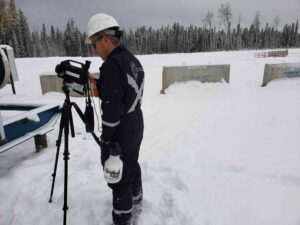
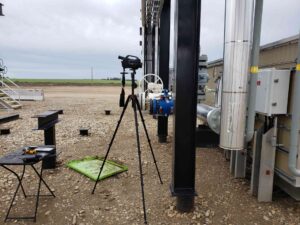 The biggest leap forward was Optical Gas Imaging (OGI). Bringing in tools like the FLIR GFx320 changed how we ran LDAR programs. Suddenly we were seeing what used to slip past even the best-trained field techs. But OGI is a skill—it’s not just aim and shoot. You’ve got to read plume behavior, understand wind dynamics, and know how to interpret thermal contrast. A great camera doesn’t make a great leak finder—field awareness does.
Ultrasonic tools have added even more depth to our programs. Especially in complex facilities or systems using nitrogen or compressed air. I still remember a job up in central Alberta where a persistent, untraceable line loss turned out to be a high-frequency ultrasonic leak in a back-pressure control setup. No visible emissions. No sound. No smell. But thousands of dollars a month just bleeding away—until we put the right tool in the right hands.
And then there’s Compressor Seal Vent (CSV) testing, which under Directive 060, has become one of the most critical field-level activities we do. The April 2025 update to that directive—Bulletin 2025-15—expanded the accepted pathways for Fugitive Emission Management Programs (FEMPs) and Alternative FEMPs (ALT-FEMP). That’s opened the door to more custom programs, but it also means the bar for documentation and defensibility just went up.
That’s why we bundle our services. If we’re already onsite running an LDAR survey or testing under MSAPR, we’ll run CSVs during the same visit. Operators don’t want a revolving door of crews. They want smart, consolidated work that respects their time and resources. And frankly, that’s how you build trust in this industry.
Why Integrated Field Services Improve Compliance Efficiency
 Technology on the back end is what keeps it all together. Our Field Tech App (FTA) captures everything from leak location and type to repair status and flow estimates. That syncs into EMIS for emissions quantification and into FEMP for tracking and compliance. The real benefit? It reduces audit exposure. Everything is clean, timestamped, and regulatory-aligned.
From Field Data to Verified Carbon Value
This is where Alberta stands apart. Because of the TIER program and Alberta’s offset credit system, verified emission reductions—like captured vent gas or eliminated leaks—can be monetized. We’ve helped clients convert LDAR and CSV data into serialized carbon offsets. That’s not theoretical. That’s real, reportable, and sellable value. I’ve seen producers turn retrofit programs into six-figure credit positions. Try doing that without a defensible, high-integrity emissions dataset.
Now, in places like Saskatchewan or BC, we still run robust LDAR programs, but the incentive structure is different. Without the same credit framework, the payoff is mostly in avoided compliance costs and improved field efficiency. And those are still worthwhile—but it’s Alberta where LDAR meets revenue.
Turning Fugitive Emissions into Measurable Business Value
I remember one Alberta operator with about a dozen facilities who had been running a barebones LDAR program—basic AVO checks and annual OGI surveys. After we upgraded them with integrated ultrasonic testing, CSV, and live repair tracking via FEMP, they not only passed their next EPAP audit but also banked over 400 tonnes of CO₂e reductions they’d never claimed before. That’s real return, and it didn’t take a massive capital outlay—just smarter execution.
At the end of the day, compliance isn’t optional, but how you get there can vary. For me, it’s always about blending the fieldwork with the bigger picture: tools that work, software that proves it, and a regulatory lens that’s sharp enough to stay ahead of the next bulletin.
When I step onto a site today—with an OGI camera in one hand and a tablet running the FTA in the other—I’m not just scanning for leaks. I’m helping that operator stay compliant, save money, and maybe even uncover new value they didn’t know was there.
And that’s what still makes this work worth doing.